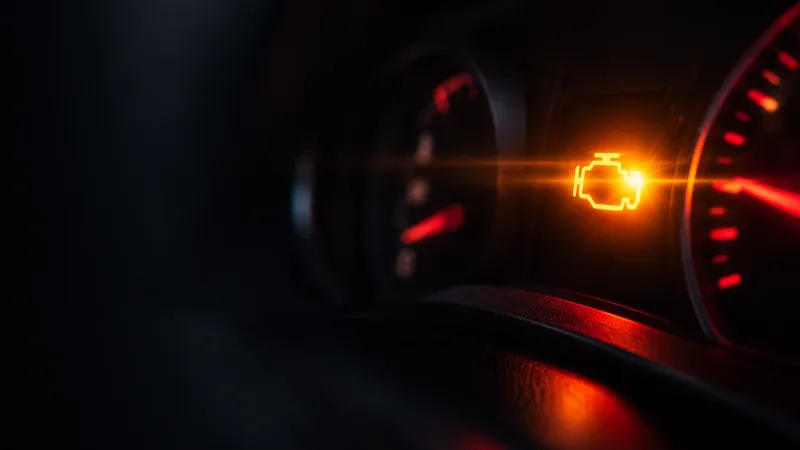
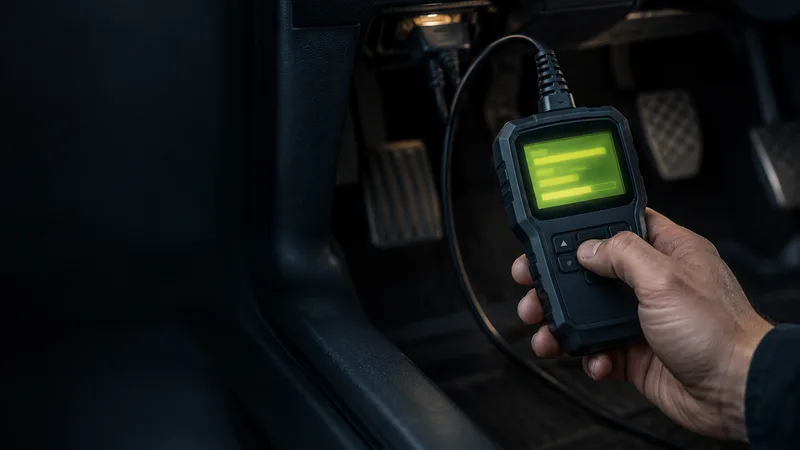
The check engine light means your car's engine computer has found a fault that could raise emissions, and it has stored a trouble code that says where to start looking. A steady light means get the code read soon; a flashing light means a misfire is happening right now that can damage the catalytic converter, so stop driving.
Key takeaways
- Steady light: a confirmed fault is stored. Usually safe to drive carefully for now, but read the code soon.
- Flashing light: an active misfire. Ram's owner's manual warns that severe catalytic converter damage "will soon occur." Pull over and see what to do when the check engine light is flashing.
- The code is the answer to "why." The light itself can't tell a loose gas cap from a failing catalytic converter; the code can.
- The light can go out on its own after three clean trips, but the code usually stays stored for a while.
- A lit light usually fails an OBD emissions inspection, and so does clearing codes right before one.
What the Check Engine Light Means
Every gasoline car and light truck sold in the US since the 1996 model year carries an on-board diagnostic system, known as OBD-II. The California Air Resources Board's fact sheet notes that the US EPA requires it on all 1996-and-newer passenger cars and trucks. That system runs self-tests on the parts that affect emissions: the catalytic converter, oxygen sensors, the fuel vapor (EVAP) system, fuel delivery, ignition and more.
When one of those self-tests fails, the computer turns on the malfunction indicator lamp. That's the official name for the check engine light, which usually looks like an engine outline and may say "Check" or "Check Engine." California's OBD regulation is strict about this: the light "may not be used for any purpose other than" what the regulation specifies, and when it comes on, a confirmed trouble code must be stored within seconds. In practice, a lit check engine light nearly always has a code behind it that a scan tool can read.
The New York State inspection program describes a steady light as a fault that could push emissions above 1.5 times the federal limit. It's a pollution alarm first. But the same faults often waste fuel or slowly damage other parts. Oregon's DEQ warns that ignoring the light can cause "significant damage" to the emission control system and lead to more expensive repairs.
Normal behavior: the light should come on for a few seconds when you turn the key, then go out after the engine starts. New York's inspection program describes this bulb check. If it goes out, the lamp itself works.
Solid vs Flashing: The One Thing to Check First
Before anything else, look at whether the light is steady or blinking. That decides whether you keep driving.
| Light | What the computer is saying | What to do |
|---|---|---|
| Steady (solid) | A fault was confirmed, usually on two drives in a row | Drive gently, read the code within days, watch for symptoms |
| Flashing | Misfire right now, bad enough to damage the catalytic converter | Stop driving as soon as it's safe. Don't keep driving to "see if it clears" |
| Comes on, then goes off | Fault seen, then not seen again for three trips | Read the stored code anyway; it often comes back |
| Never comes on at key-on | The bulb or its circuit may be bad | Have it checked; an inspection will fail on this alone |
The flashing pattern is required by federal rule. Under 40 CFR 86.1806-05, the light must blink once per second during any engine misfire where catalyst damage is imminent. Ram's owner's manual says a flashing light means "severe catalytic converter damage and power loss will soon occur" and that immediate service is required. Honda's manual says to "stop in a safe place and wait for the engine to cool down."
That's why a flashing light gets its own page: check engine light flashing — stop driving.
What to Do Right Now
If the light is steady and the car feels normal:
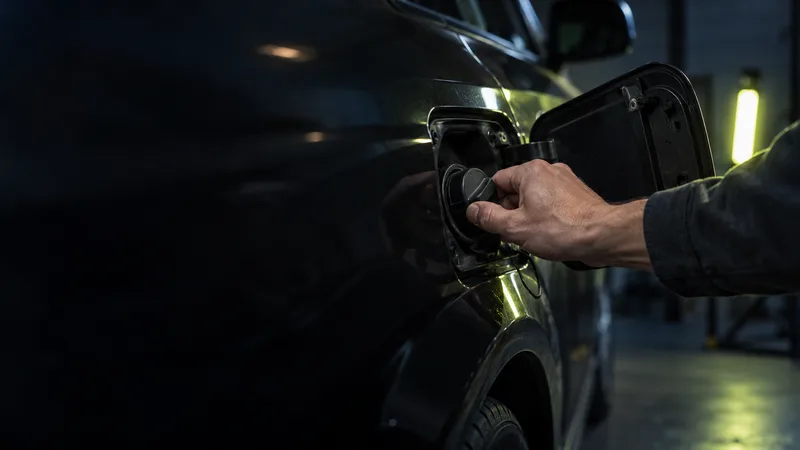
- Check the gas cap. If it's loose, tighten it until it clicks. Toyota's and Ram's owner's manuals both name a loose or missing cap as a cause. The light won't go off right away; see gas cap and the check engine light for how long it takes.
- Notice how the car drives. Rough idle, shaking, hesitation, a fuel smell or a rising temperature gauge all make the problem more urgent.
- Read the code within a few days. It tells you which system failed its self-test.
- Don't clear it yet. Clearing erases the clues and resets the readiness monitors an inspection needs. Our guide on how to clear the check engine light explains when clearing makes sense.
If the light is flashing, or it's steady but you also notice any of the following, stop driving and have the car inspected:
- The engine shakes, stumbles or loses power.
- The temperature gauge climbs toward hot.
- You smell fuel or something burning, or see smoke.
- Another red warning light is on, such as oil pressure or charging.
Ram's manual adds a specific fire warning: an overheating catalytic converter "can cause a fire if you drive slowly or park over flammable substances" such as dry grass.
Flashing light: don't keep driving to reach a shop across town. Stop somewhere safe, away from dry grass or leaves, and turn the engine off. If the light flashes again after a restart, arrange a tow instead of driving on.
How to Read the Code
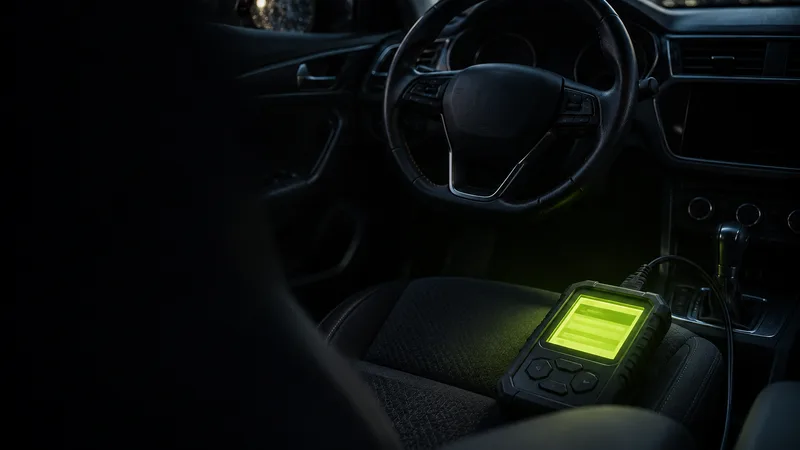
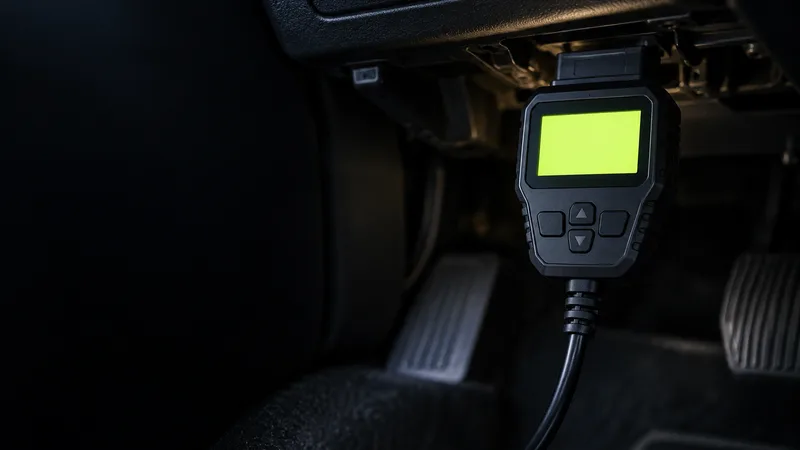
Every OBD-II car has a standard diagnostic connector. California's OBD rule places it in the driver's side footwell area, no higher than the bottom of the steering wheel, so look low under the dash. A scan tool or plug-in reader connects there and asks the computer for its stored codes.
You'll get one or more five-character codes such as P0420 or P0171. The first letter shows the area of the car (P for powertrain), and the rest pinpoints the fault. Our guide to what a DTC is breaks down the format, including the extra two characters some tools add (like P0420-00).
Once you have the code:
- Look it up here. Type it into the code lookup on the home page, or go straight to its page, for example P0420 or P0300. Each code page starts with how serious the code is, then ranks the likely causes and the next test.
- Write down every code, not just the first. Two codes together often point to one shared cause.
- Note whether codes are "pending" or "confirmed." Many tools show both. A pending code means the computer saw the fault once and is waiting to see it again. Our guide on pending, stored and permanent codes explains the difference.
If the reader finds no codes while the light is on, something unusual is going on. See check engine light on but no code.
Common Causes, Grouped by System
The light only says "a self-test failed." The code says which one. Below are the systems behind the codes drivers look up most, with what each one tells you and how it changes your next step.
Fuel vapor leaks (EVAP)
The EVAP system traps fuel vapor from the tank and burns it in the engine instead of venting it. California's regulation requires the computer to detect leaks as small as a 0.020-inch hole. Codes such as P0455 (large leak), P0442 (small leak) and P0456 (very small leak) are the classic "drives fine, light's on" codes.
Why it matters for your next step: these are rarely urgent, and a large-leak code is the one most worth checking against the gas cap first. Browse all EVAP codes.
Misfires
A misfire means a cylinder didn't burn its fuel properly. P0300 means misfires in more than one cylinder or random ones; P0301 through P0306 name the cylinder. A misfire is the code most likely to come with a flashing light.
Why it matters: a misfire is a symptom, not a cause. Spark, fuel or air can each cause it, and a lean code alongside a misfire changes which one to suspect. See misfire codes.
Fuel trim (running lean or rich)
The computer constantly adjusts fuel to hit the right air-fuel mix. When it has to add or remove more fuel than allowed, it sets P0171 or P0174 (lean) or P0172 (rich).
Why it matters: a lean code on both engine banks at once (P0171 and P0174 together) points to something both banks share, like unmetered air or a fuel supply problem, rather than one side of the engine. See fuel trim codes.
Air metering
The mass airflow (MAF) sensor measures air entering the engine. Codes like P0101, P0102 and P0113 mean its readings, or the intake air temperature reading, don't make sense.
Why it matters: a bad airflow reading can cause fuel trim codes downstream, so an air-metering code next to a lean code is often the place to start. See air metering codes.
Catalytic converter
P0420 and P0430 mean the converter on bank 1 or bank 2 isn't storing and releasing oxygen the way a healthy one does, judged by comparing the oxygen sensors before and after it.
Why it matters: a catalyst code is often the last link in a chain. Misfires and rich running damage converters, so if you also have misfire or fuel codes, fix those first or a new converter may fail too. See catalyst codes.
Oxygen sensors
Codes like P0135 and P0141 (sensor heater circuits) or P0137 and P0138 (low or high voltage) point at the sensors themselves or their wiring.
Why it matters: a heater-circuit code is about the sensor's electrical side, which is a different test from a sensor that reads wrong. See oxygen sensor codes.
Variable valve timing
P0011, P0014, P0016 and P0017 mean the camshaft isn't where the computer expects it relative to the crankshaft.
Why it matters: the code number tells you which bank and which camshaft (intake or exhaust) is out of position, which narrows the test before any part is replaced. A cam-crank correlation code like P0016 is a different problem from a cam that won't follow the computer's commands. See valve timing codes.
Cooling and transmission
P0128 means the engine is taking too long to warm up, which often points at the thermostat. It's a different problem from overheating, which comes with a temperature warning and is a reason to stop. P0700 means the transmission computer has stored its own code; that code needs a tool that can read the transmission module. See cooling codes and transmission codes.
When You Have More Than One Code
Several codes at once usually aren't several problems. One fault often trips self-tests in other systems:
- A vacuum leak can set lean codes, then misfires, then eventually a catalyst code.
- A bad airflow reading can set fuel trim codes.
- Misfires can set a catalyst code, because unburned fuel overheats the converter.
The order you fix things in matters. Enter all of your codes in the multi-code diagnosis tool to see which one is likely the cause and which ones are likely follow-on codes, along with the highest severity among them.
When the Light Behaves Oddly
The light is on but the reader shows no codes. Because the regulation requires a stored code whenever the light is on, this usually points to the reader, the connection, or a different warning light. See check engine light on but no code.
The light went off, but a code is still there. Federal rules let the light go out after three trips without the fault, while the code can stay in memory for up to 40 engine warm-ups. See check engine light off but code still there.
The light comes back after clearing. Clearing a code doesn't fix the cause. If the fault is still there, the self-test fails again and the light returns. Our clearing guide covers why.
The Check Engine Light and Emissions Inspection
In states that test cars by plugging into the OBD port, a lit check engine light is usually a fail. Federal inspection rules (40 CFR 85.2222) say a car with codes that turned the light on "shall fail" the OBD inspection. California's Smog Check fails a car when the light is on with the engine running.
Clearing the codes right before a test rarely helps. It resets the car's readiness monitors, and the test checks those too. Federal rules fail a car with too many incomplete monitors. California also fails cars with "permanent" codes that a scan tool can't erase. Our guide on pending, stored and permanent codes explains how that works.
Questions drivers ask
Is it safe to drive with the check engine light on?
If the light is steady and the car drives normally, it is usually fine to drive carefully while you get the code read soon. If the light is flashing, or the car runs rough, loses power, overheats or smells hot, stop driving and have it checked. Owner's manuals describe a flashing light as a misfire that can quickly damage the catalytic converter.
Why is my check engine light on if the car drives fine?
Many faults the light reports affect emissions before you can feel them, such as a small leak in the fuel vapor system or a slow oxygen sensor. A loose gas cap is one example that owner's manuals name. The car can feel normal while the computer has already stored a code.
Will the check engine light turn off by itself?
It can. Federal rules let the light go out if the fault doesn't return for three trips in a row. The code usually stays in memory for a while after that, so the light going out doesn't mean nothing happened.
Can a loose gas cap turn on the check engine light?
Yes. Toyota and Ram owner's manuals both list a loose fuel cap as a cause. Tightening it won't turn the light off right away; Toyota says it goes off after several driving trips.
Does a check engine light mean I'll fail inspection?
In states with OBD-based emissions testing, usually yes. Federal inspection rules fail a car with codes that turned the light on, and California's Smog Check fails a car if the light is on with the engine running.
Sources & further reading
- California Air Resources Board (CARB) — Board Diagnostic Ii Obd Ii Systems Fact Sheet https://ww2.arb.ca.gov/resources/fact-sheets/board-diagnostic-ii-obd-ii-systems-fact-sheet Open source ↗
- nyvip3.com — CheckEngineLight https://nyvip3.com/OBDII/CheckEngineLight Open source ↗
- vehicleinfo.mopar.com — GUID F1C2D92A 05FC 41AF B9A0 287CE3AC362F https://vehicleinfo.mopar.com/assets/publications/en-us/Ram/2022/2500_3500/om_html/GUID-F1C2D92A-05FC-41AF-B9A0-287CE3AC362F.html Open source ↗
- honda.ca — GUID F55CE315 6AF3 4A95 93B5 FDDE6A874B89 https://www.honda.ca/Content/ownermanuals/htmlPublication/a7354496a48d4610286a7a2f261086de020a____/20180926/GUID-F55CE315-6AF3-4A95-93B5-FDDE6A874B89.html Open source ↗
- govinfo.gov — CFR 2012 Title40 Vol20 Sec86 1806 05 https://www.govinfo.gov/content/pkg/CFR-2012-title40-vol20/pdf/CFR-2012-title40-vol20-sec86-1806-05.pdf Open source ↗
- law.cornell.edu — 13 CCR 1968.2 https://www.law.cornell.edu/regulations/california/13-CCR-1968.2 Open source ↗
- assets.sia.toyota.com — OM52G61U https://assets.sia.toyota.com/publications/en/om-s/OM52G61U/pdf/OM52G61U.pdf Open source ↗
- oregon.gov — OBD https://www.oregon.gov/deq/Vehicle-Inspection/Pages/OBD.aspx Open source ↗
- law.cornell.edu — 85.2222 https://www.law.cornell.edu/cfr/text/40/85.2222 Open source ↗
- bar.ca.gov — Obd Test Reference https://www.bar.ca.gov/obd-test-reference Open source ↗
- California Air Resources Board (CARB) — Attacha https://ww2.arb.ca.gov/sites/default/files/barcu/regact/obd02/attacha.pdf Open source ↗