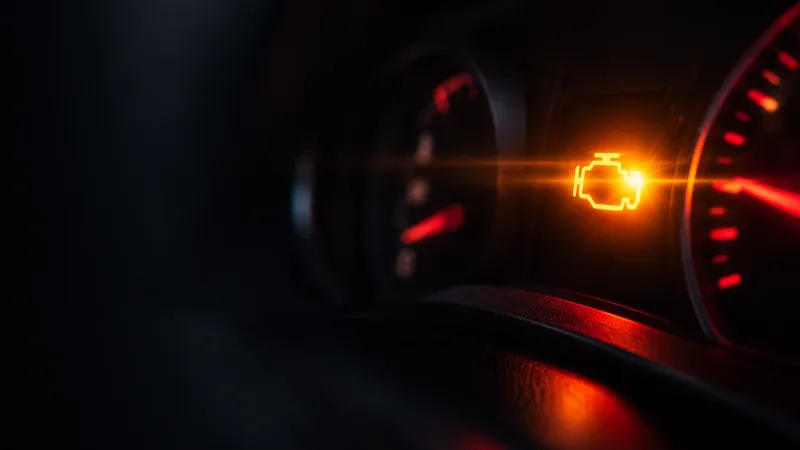
Yes, a loose or missing gas cap can turn on the check engine light, usually with an EVAP leak code such as P0457 or P0455. Tighten the cap until it clicks. The light won't go off right away: Honda's owner's manual says it takes three driving trips, and Toyota's says several.
Key takeaways
- A loose cap is a real cause. Toyota, Honda and Ram owner's manuals all list a loose or missing fuel cap as a reason for the check engine light.
- Typical codes: P0457 (cap loose or off), P0455 (large leak), and sometimes P0442 or P0456 from a worn seal.
- Tighten, inspect, then drive. Check that the cap clicks, the seal isn't cracked and it's the right cap for the car.
- Expect a few days. The EVAP leak test runs only under specific conditions, such as a cold start and a tank that isn't nearly full.
- No change after a week or two of normal driving? The leak is probably somewhere else in the EVAP system.
Why a Gas Cap Can Turn On the Light
Your fuel tank is part of a sealed system called EVAP (evaporative emissions). It stores fuel vapor in a charcoal canister and later draws it into the engine to burn, rather than letting it escape. The engine computer regularly checks that system for leaks.
The check is sensitive. California's OBD regulation requires the computer to detect leaks equal to a hole 0.040 inch across, and in newer cars a hole just 0.020 inch across. A cap that isn't sealed leaks far more than that, so the test fails and the light comes on.
That's why owner's manuals name the cap directly. Honda's says the light can mean "the fuel cap is missing or loose." Ram's lists "a loose or missing gas cap" among conditions that may turn the light on.
Some cars handle this differently. California's rule lets a manufacturer use a separate fuel-cap warning instead of the check engine light when the car can tell the leak is from the cap. Some newer cars have a capless filler. Ford's Easy Fuel system closes and latches itself when the nozzle comes out, so there's no cap to leave loose.
Which Codes a Gas Cap Sets
| Code | Meaning | How it relates to the cap |
|---|---|---|
| P0457 | EVAP leak detected, fuel cap loose/off | The computer has concluded the cap is the likely leak |
| P0455 | EVAP large leak | A missing or loose cap is one of the first things to check |
| P0442 | EVAP small leak | A worn or cracked cap seal can cause it; so can small hose leaks |
| P0456 | EVAP very small leak | A tiny leak; a cap seal is one possibility among several |
Each code page covers its own causes and tests in order. For example, the P0455 page ranks what to check after the cap. If the code isn't one of these, browse all EVAP codes.
How to Check the Gas Cap
This is one of the few checks on a car that's low-risk for anyone. Do it with the engine off, and don't smoke or use an open flame nearby.
- Remove the cap and look at the seal. The rubber O-ring or gasket should be whole, flexible and clean. Look for cracks, flat spots, tears or dirt.
- Check the filler neck. Look for debris on the sealing surface, or damage where the cap seats.
- Make sure it's the right cap. Saab's service procedure for P0457 asks whether the cap is genuine and says to replace it if not. An ill-fitting aftermarket cap may not seal.
- Reinstall and tighten until it clicks. Most screw-on caps ratchet when tight. Then give it a gentle tug to confirm it's seated.
- Watch for a caught tether. The same Saab procedure notes the code can set if "the cap chain was caught while tightening."
If the seal is damaged, replace the cap with the correct one for your vehicle. If everything looks fine, tighten it and move on to the waiting step below.
How Long Until the Light Goes Off
The light won't turn off the moment you tighten the cap. The car needs to run its EVAP leak test again and pass.
- Honda's owner's manual: "Tightening the cap will not make the indicator turn off immediately; it takes three driving trips."
- Toyota's owner's manual: "The malfunction indicator lamp will go off after several driving trips."
- Federal rule: the light "may be extinguished if the malfunction does not reoccur during three subsequent sequential trips" (40 CFR 86.1806-05).
The code itself lasts longer. Toyota's manual says a cap-related code won't clear unless the vehicle is driven 40 or more times, which matches the federal 40 warm-up cycle rule. So a scan tool may still show the code after the light is off. That's expected; see check engine light off but code still there.
You can clear the code with a scan tool instead, but it resets your inspection readiness monitors and proves nothing about the fix. Our guide on how to clear the check engine light covers the trade-offs.
Why the EVAP Test Takes Its Time
"Three trips" means three trips where the EVAP test actually runs, and it doesn't run on every drive. California's OBD regulation shows why:
- Fuel level: manufacturers may skip the test when the tank is over 85 percent full or during refueling. Filling up right after tightening the cap can delay it.
- Cold starts: a manufacturer may run the test only on drives that begin as cold starts.
- Weather and drive length: when the rule counts a fair chance for the EVAP test to run, it uses a cold start with the engine near outside temperature, outside air between 40°F and 95°F, and at least 10 minutes of running.
Each manufacturer sets its own exact conditions within those limits. In practice, short trips, a full tank or very hot or cold weather can all stretch the wait. Normal daily driving, starting from a cold engine with a tank between full and empty, gives the test the most chances to run.
When It's Not the Cap
If the cap was clearly loose and the light goes out after a few drives, you're done. If not, the cap may have been a coincidence. Signs the leak is elsewhere:
- The light stays on after a week or two of normal driving that included cold starts.
- The code comes back after you clear it.
- The cap and seal looked fine from the start.
- You have other EVAP codes, such as P0440, P0441 or P0446, which point at the system's purge and vent controls or its overall operation rather than a simple leak.
The EVAP system has hoses, a purge valve, a vent valve and a charcoal canister, and any of them can leak. Shops usually find leaks with a smoke test. Each EVAP code page lists the next test for that code. If you have several codes, try the multi-code tool.
A gas cap never makes the light flash. A flashing check engine light means an active misfire. Stop driving and see check engine light flashing.
For what other codes behind the light can mean, start at the check engine light guide.
Questions drivers ask
How long does it take for the check engine light to go off after tightening the gas cap?
Not immediately. Honda's owner's manual says it takes three driving trips, and Toyota's says the light goes off after several driving trips. The EVAP leak test only runs under certain conditions, so it can take longer if those trips don't include them.
What code does a loose gas cap cause?
Usually an EVAP leak code. P0457 means a leak with the fuel cap loose or off; P0455 is a large leak, which a missing or loose cap can cause. A worn cap seal can also show up as a small leak, P0442, or a very small leak, P0456.
Can I drive with the check engine light on from a loose gas cap?
Generally yes, if the light is steady and the car drives normally. A cap leak lets fuel vapor escape but doesn't affect how the engine runs. If the light is flashing, it's not a gas cap problem; stop driving.
Should I clear the code after tightening the gas cap?
You can, but there's little benefit. Clearing resets the readiness monitors an emissions test checks, and if the cap wasn't the cause the light will return. Letting the car turn the light off itself confirms the fix.
Does a new gas cap fix the check engine light?
Only if the old cap was the problem. A Saab service procedure for P0457 checks whether the cap is tight, whether it's a genuine part, and whether the seal is damaged. If the cap passes those checks, the leak is elsewhere in the EVAP system.
Sources & further reading
- assets.sia.toyota.com — OM52G61U https://assets.sia.toyota.com/publications/en/om-s/OM52G61U/pdf/OM52G61U.pdf Open source ↗
- techinfo.honda.com — RL0000O00284A https://techinfo.honda.com/rjanisis/pubs/OM/RL0000/RL0000O00284A.pdf Open source ↗
- honda.ca — GUID F55CE315 6AF3 4A95 93B5 FDDE6A874B89 https://www.honda.ca/Content/ownermanuals/htmlPublication/a7354496a48d4610286a7a2f261086de020a____/20180926/GUID-F55CE315-6AF3-4A95-93B5-FDDE6A874B89.html Open source ↗
- vehicleinfo.mopar.com — GUID F1C2D92A 05FC 41AF B9A0 287CE3AC362F https://vehicleinfo.mopar.com/assets/publications/en-us/Ram/2022/2500_3500/om_html/GUID-F1C2D92A-05FC-41AF-B9A0-287CE3AC362F.html Open source ↗
- saabwisonline.com — Dtc P0457 Evaporative Emission Control System Leak Detected Fuel Cap Loose Off https://saabwisonline.com/9-2x-9346/2005/2-engine/engine-diagnostics-2-5i/diagnostic-procedure-with-diagnostic-trouble-code-dtc/fault-diagnosis-fault-codes/dtc-p0457-evaporative-emission-control-system-leak-detected-fuel-cap-loose-off Open source ↗
- California Air Resources Board (CARB) — Attacha https://ww2.arb.ca.gov/sites/default/files/barcu/regact/obd02/attacha.pdf Open source ↗
- ford.com — How Do I Use The Easy Fuel Capless Fuel Filler https://www.ford.com/support/how-tos/more-vehicle-topics/fuel-and-fuel-economy/how-do-i-use-the-easy-fuel-capless-fuel-filler/ Open source ↗
- govinfo.gov — CFR 2012 Title40 Vol20 Sec86 1806 05 https://www.govinfo.gov/content/pkg/CFR-2012-title40-vol20/pdf/CFR-2012-title40-vol20-sec86-1806-05.pdf Open source ↗