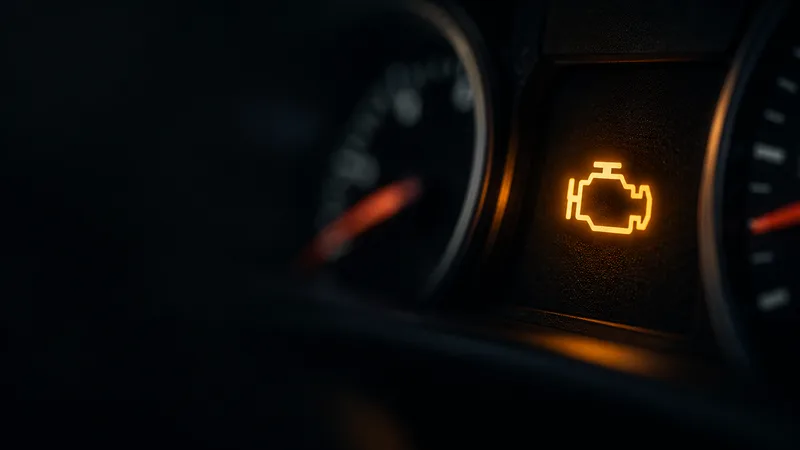
A flashing check engine light means the engine is misfiring right now, badly enough to damage the catalytic converter. Pull over as soon as it's safe, park away from anything that can burn, and turn the engine off. Don't keep driving.
Key takeaways
- Flashing means stop. Federal rules require the light to blink once per second when misfire is bad enough that catalyst damage is imminent.
- The risk is heat. Unburned fuel burns inside the converter. Ram's manual warns an overheating converter "can cause a fire" if you park over flammable material.
- Stop on pavement, away from dry grass and leaves, and let the engine cool.
- If it flashes again after a restart, don't drive it. Get it towed.
- Expect a misfire code: P0300 (random or multiple cylinders) or P0301 to P0306 (one cylinder).
What a Flashing Light Means
A steady check engine light means a fault was confirmed. A flashing one is a different message: something harmful is happening as you drive.
The federal OBD rule for cars and light trucks, 40 CFR 86.1806-05, puts it plainly: the light "must blink once per second under any period of operation during which engine misfire is occurring and catalyst damage is imminent." California's OBD regulation has the same blink requirement for misfire.
Here's why a misfire threatens the converter. When a cylinder doesn't fire, its fuel and air go out the exhaust unburned. That mix reaches the catalytic converter, which is already hot, and burns there. The converter gets far hotter than it's designed to run. Ram's owner's manual says a flashing light means "severe catalytic converter damage and power loss will soon occur" and that immediate service is required.
So the light is protecting two things: an expensive emissions part, and you. A converter that hot sits under the floor, close to whatever you park on.
What to Do Right Now
- Ease off the accelerator. Don't speed up to "push through" it. Your only goal now is a safe place to stop.
- Turn on your hazards and pull over as soon as it's safe. A parking lot or wide paved shoulder is best.
- Park on pavement, not grass. Ram's manual warns that a malfunctioning converter can start a fire "if you drive slowly or park over flammable substances such as dry plants, wood, cardboard."
- Turn the engine off and let it cool. Honda's owner's manual says to "stop in a safe place and wait for the engine to cool down."
- Look and listen from a safe spot. If you see smoke or smell burning, move away from the car and call for help.
- Decide how to move the car. If the light flashes again when you restart, or the engine shakes, stalls or lacks power, don't drive it. Arrange a tow.
Don't drive with a flashing check engine light. If you're on a highway and can't stop yet, drive gently and take the first safe place to pull off.
What Not to Do
- Don't keep driving to see if it clears. The blinking stops only when the misfire eases. That doesn't mean the problem is gone.
- Don't clear the code and drive on. Clearing turns the light off, not the misfire. You lose the stored data a technician uses, and the converter keeps taking damage.
- Don't park over grass, leaves, wood or cardboard while the exhaust is hot. Those are the kinds of materials Ram's manual names as a fire risk.
- Don't start swapping parts at the roadside. Coils, plugs and injectors are all possible causes, and guessing wastes money. The code and a proper test narrow it down.
Codes You'll Likely See
When the code is read, a flashing light almost always comes with a misfire code. The code number tells you where the misfire is:
| Code | What it means | What it suggests about the cause |
|---|---|---|
| P0300 | Random or multiple-cylinder misfire | Something shared by all cylinders: fuel pressure, a vacuum leak, airflow reading, fuel quality |
| P0301 | Cylinder 1 misfire | A part specific to that cylinder: coil, plug, injector, or compression |
| P0302 | Cylinder 2 misfire | Same as above, for cylinder 2 |
| P0303 | Cylinder 3 misfire | Same as above, for cylinder 3 |
| P0304 | Cylinder 4 misfire | Same as above, for cylinder 4 |
| P0305 | Cylinder 5 misfire | Same as above, for cylinder 5 |
| P0306 | Cylinder 6 misfire | Same as above, for cylinder 6 |
The pattern of codes tells you more than any single code:
- One cylinder code points at that cylinder. A shop will often swap the coil or plug to a different cylinder and see if the misfire follows it.
- P0300 alone points toward something the whole engine shares.
- Misfire codes plus a lean code (P0171 or P0174) suggest the engine is running too lean to fire reliably. The lean condition is often the thing to fix first.
- Misfire codes plus a catalyst code (P0420 or P0430) may mean the converter has already been hurt. Fix the misfire before judging or replacing the converter.
If you have several codes, enter them all in the multi-code diagnosis tool to see which is likely primary. All of these are listed under misfire codes.
If It Stops Flashing
Because the light blinks only while the damaging misfire is happening, it can switch to steady, or go out entirely, once the misfire eases. That isn't a sign the car is fixed. The misfire usually comes back under the same conditions. Treat a car that has flashed as one that needs diagnosis before normal driving. The light may also go out after a few clean trips while the code stays stored; see check engine light off but code still there.
For what a steady light means and the other causes behind it, see the main check engine light guide.
Getting the Car to a Shop
If the light flashes again after the engine has cooled and you restart, or the engine runs rough, the safest way to move the car is on a tow truck. A flatbed keeps the drive wheels off the ground, so the engine doesn't need to run at all.
When you call a shop, give them the details that help with diagnosis:
- Whether the light was flashing or steady, and when it started (cold start, highway speed, going uphill).
- Any recent work: new plugs, coils, a fuel fill-up just before it started.
- Every code you've read, if you have them.
Questions drivers ask
Why is my check engine light flashing?
The engine is misfiring badly enough that unburned fuel is reaching the catalytic converter. Federal rules require the light to blink whenever misfire is severe enough that catalyst damage is imminent. It's the one check engine light pattern that means stop.
Can I drive with a flashing check engine light?
You shouldn't. Ram's owner's manual says severe catalytic converter damage and power loss will soon occur, and Honda's says to stop in a safe place and let the engine cool. Driving on turns a misfire repair into a misfire plus a converter, and the hot converter is a fire risk.
Why does my check engine light flash and then go steady?
The light blinks only while the damaging misfire is happening. If the misfire eases, it may switch to steady or go out. The fault is still there; treat the car as unsafe to drive until it's diagnosed.
Is a flashing check engine light always a misfire?
On OBD-II cars, the federal rule ties the blinking light to engine misfire that threatens the catalyst. Expect a misfire code such as P0300 or P0301 to P0306 when the code is read. If no misfire code shows up, have a shop read all modules.
Sources & further reading
- govinfo.gov — CFR 2012 Title40 Vol20 Sec86 1806 05 https://www.govinfo.gov/content/pkg/CFR-2012-title40-vol20/pdf/CFR-2012-title40-vol20-sec86-1806-05.pdf Open source ↗
- California Air Resources Board (CARB) — Attacha https://ww2.arb.ca.gov/sites/default/files/barcu/regact/obd02/attacha.pdf Open source ↗
- vehicleinfo.mopar.com — GUID F1C2D92A 05FC 41AF B9A0 287CE3AC362F https://vehicleinfo.mopar.com/assets/publications/en-us/Ram/2022/2500_3500/om_html/GUID-F1C2D92A-05FC-41AF-B9A0-287CE3AC362F.html Open source ↗
- honda.ca — GUID F55CE315 6AF3 4A95 93B5 FDDE6A874B89 https://www.honda.ca/Content/ownermanuals/htmlPublication/a7354496a48d4610286a7a2f261086de020a____/20180926/GUID-F55CE315-6AF3-4A95-93B5-FDDE6A874B89.html Open source ↗
- nyvip3.com — CheckEngineLight https://nyvip3.com/OBDII/CheckEngineLight Open source ↗